
Reading time: 9 min
A campaign that launched well and then quietly stopped performing is one of the most frustrating situations in outbound email. Reply rates drop, meetings dry up, and nothing obvious has changed. The instinct is usually to rewrite the copy. But copy is rarely the only problem. Campaigns stop working for specific, diagnosable reasons, and most of them run deeper than the subject line.
Table of contents
- Why campaigns decline over time
- The five most common reasons campaigns stop working
- How to diagnose the real problem
- Fixing a burned domain and sender reputation
- Fixing a targeting issue
- Fixing a messaging and content issue
- When to pause versus when to optimize
- FAQ
Why campaigns decline over time
Outbound email campaigns do not operate in a static environment. Mailbox providers update their filtering algorithms. Prospect lists get exhausted. Buyer priorities shift with market conditions. A campaign built and optimized for one moment in time will naturally drift out of alignment with the environment it is running in.
This is not a failure of the original setup. It is a predictable pattern that every long-running campaign encounters. The difference between a campaign that recovers and one that continues to decline is whether the team running it treats declining performance as a signal to investigate or an inevitability to accept.
The five most common reasons campaigns stop working
1. Domains have burned out from accumulated complaints
This is the most damaging and hardest to reverse cause of campaign failure. When prospects receive irrelevant or poorly targeted emails, enough of them mark those emails as spam. Over time, those complaint signals accumulate against the sending domain. Once a domain crosses a threshold with major email service providers like Google or Microsoft, it gets blacklisted. Emails sent from that domain stop reaching inboxes entirely, regardless of how good the content is.
The root cause is almost always content and targeting, not a technical failure. A domain does not get burned because of a misconfigured DNS record. It gets burned because the emails it was sending were not relevant enough to the people receiving them.
2. The list is exhausted
Every targeted list has a finite number of relevant prospects. Once a campaign has worked through most of the genuinely qualified contacts on a list, performance naturally declines as it reaches less relevant or previously unresponsive prospects. This is especially common in campaigns targeting a narrow niche or a specific geography.
3. The offer has become stale
An offer that felt fresh and specific when a campaign launched can feel generic months later, either because competitors are now making similar offers or because the prospect’s situation has shifted enough that the original pain point no longer resonates as strongly.
4. Buyer priorities have shifted
Market conditions, economic pressure, and seasonal factors all affect what a buyer cares about right now. A campaign built around a pain point that was urgent six months ago may be speaking to a problem that has since been deprioritized, solved internally, or replaced by a more pressing concern.
5. Copy fatigue in a saturated market
In competitive industries, the same outbound approaches get replicated quickly. An opening hook or email format that generated strong replies early in a campaign often gets copied by others in the same space, making the original approach feel familiar and easy to ignore.
How to diagnose the real problem
Before making any changes, it is worth identifying which layer of the campaign is actually failing. The primary metric for diagnosing outbound performance is reply rate. Not open rates, not click rates. Replies are the only signal that actually measures whether the campaign is achieving its purpose.
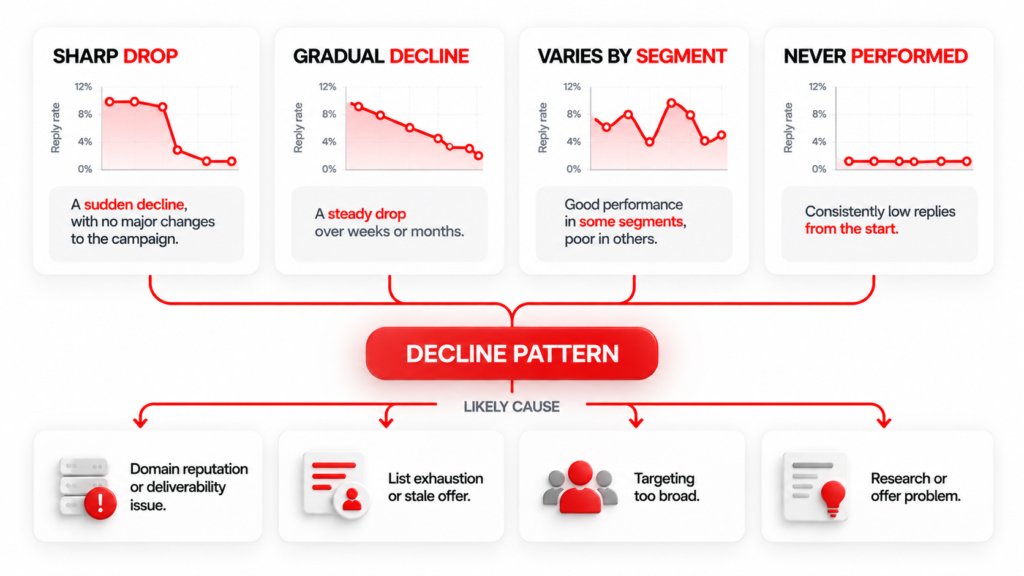
- If reply rates have dropped sharply with no change to messaging or targeting, the most likely culprit is domain reputation. Emails may be reaching inboxes less consistently, or prospects who do receive them are not finding them relevant enough to respond.
- If reply rates have declined gradually over weeks or months, the list is likely approaching exhaustion, or the offer has drifted out of alignment with what the target persona currently cares about.
- If reply rates vary significantly across different segments of the list, the targeting definition may be too broad, with some segments responding well and others dragging the overall numbers down.
- If the campaign has never had strong reply rates, the issue is almost certainly in the research and offer, not in the infrastructure.
Fixing a burned domain and sender reputation
A burned domain is a serious problem because it cannot be unburned quickly. Once an email service provider has flagged a domain based on accumulated complaint signals, recovery is slow and uncertain. The more practical response is prevention and replacement rather than rehabilitation.
Steps to take:
- Stop sending from the affected domain immediately. Continuing to send from a domain that has burned accelerates the damage and risks contaminating associated domains.
- Set up fresh sending infrastructure. New domains need to be registered, properly configured with authentication records, and fully warmed up before any campaign volume goes out.
- Address the content and targeting before sending anything new. The reason the previous domain burned was that the emails were generating complaints. Sending the same content from a new domain will produce the same result. The offer, the targeting, and the messaging all need to be rebuilt around better research before a new domain is put to use.
- Use multiple domains from the start. Spreading campaign volume across several properly warmed domains reduces the risk concentrated on any single sending property, and gives the campaign more resilience if one domain encounters problems.
The fundamental lesson from a burned domain is this: deliverability problems are content problems in disguise. A campaign that generates enough complaints to burn a domain was not sending relevant enough emails to the right people.
Fixing a targeting issue
If the diagnosis points to list exhaustion or poor targeting fit, the fix requires rebuilding or refreshing the prospect pool.
Steps to take:
- Revisit the ideal customer profile. Has the target market shifted? Are there adjacent segments that were not considered in the original campaign setup?
- Build a fresh list from updated criteria. Do not reuse an exhausted list. Start with verified, current data based on an updated buyer persona and ICP definition.
- Verify all contacts before sending. Any list that has been sitting unused for several months should be re-verified before being reintroduced to a campaign.
- Consider narrowing the targeting further. A more tightly defined target segment often performs better than a broader one, since it allows for more specific messaging and a higher relevance-to-volume ratio.
Fixing a messaging and content issue
This is where most campaign recovery actually happens, and it is also the fix that prevents future domain burnout. The goal is not to write a better email. It is to rebuild the offer around research so precise that the prospect’s reaction is interest rather than irritation.
Steps to take:
- Go back to buyer persona research. Has the target persona’s situation changed? Are there new pain points or pressures that were not present when the original campaign was built?
- Rebuild the offer around what the buyer cares about right now. A refreshed offer should address the prospect’s current situation, not the situation they were in six months ago.
- Make the email feel like it was written for one person. Generic emails addressed to a broad audience generate complaints. Emails that reference a specific, real situation for a specific, real person generate replies. The more specific the content, the lower the complaint risk.
- Test fundamentally different approaches, not just variations. If a particular email structure has stopped generating replies, trying minor variations of the same structure will not produce meaningfully different results. A genuine change in angle, offer, or framing is required.
When to pause versus when to optimize
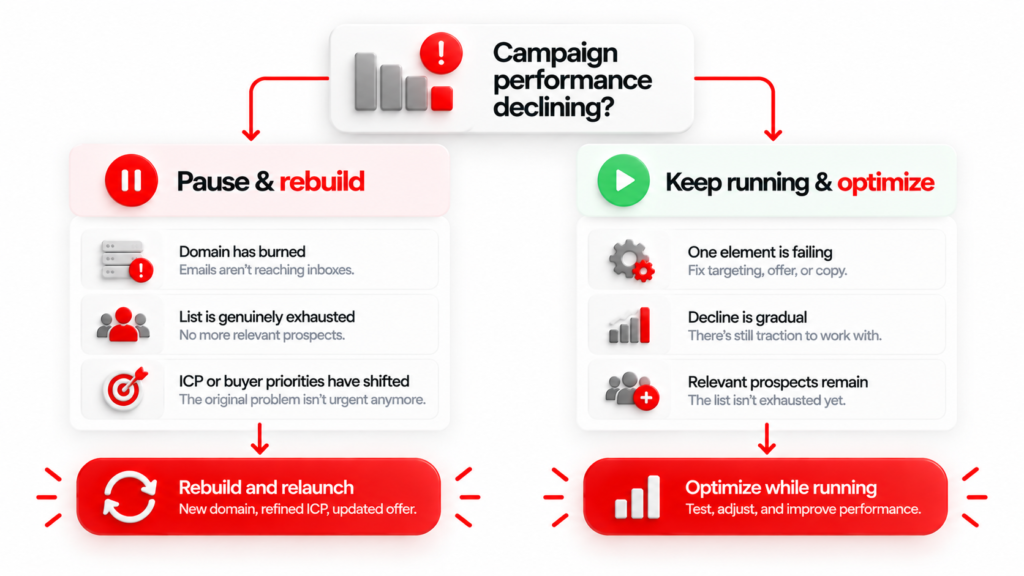
Not every declining campaign should be optimized. Sometimes the right decision is a full pause to rebuild before relaunching.
Pause and rebuild when:
- The sending domain has burned and fresh infrastructure needs to be set up and warmed before any volume goes out
- The original list is genuinely exhausted with no clear path to a refreshed target segment
- The buyer persona or ICP has shifted enough that the entire campaign premise needs to be reconsidered
Optimize without pausing when:
- The issue is isolated to one element such as the offer or a subset of the list, while other elements are still performing
- Reply rates have declined gradually rather than sharply, suggesting a drift issue rather than a structural failure
- The list still has a meaningful number of uncontacted, relevant prospects remaining
FAQ
How do you know if a domain has been blacklisted by major email service providers?
Blacklist monitoring tools can identify whether a domain or sending IP appears on major blocklists. A sudden sharp decline in replies with no changes to messaging or targeting is often the first practical signal that something has changed with deliverability, even before a formal blacklist check confirms it.
Is it worth trying to re-engage prospects who did not respond the first time?
Sometimes, but only with a meaningfully different offer or angle, not just a follow-up nudge. A prospect who ignored the original campaign needs a genuine reason to reconsider, not a reminder that they did not reply.
How often should a running campaign be reviewed for performance?
At minimum monthly, with a more detailed review every quarter. Fast-moving markets may warrant more frequent reviews, since buyer priorities and competitive dynamics can shift quickly.
Can a burned domain ever be recovered?
In some cases yes, but recovery is slow and unreliable. For most outbound campaigns, setting up fresh sending infrastructure and rebuilding the content is faster and more dependable than attempting to rehabilitate a domain that major providers have already flagged.
Why do some campaigns burn domains faster than others?
The speed of domain burnout is directly tied to the relevance and targeting quality of what is being sent. A campaign sending precisely targeted, highly relevant emails to a well-researched list generates far fewer complaints than a campaign sending generic pitches to a broad, loosely matched audience.
A campaign that has stopped working is not necessarily a failed campaign. It is a campaign that has reached the edge of what its current setup can do, and is signaling that it is time to rebuild from updated research rather than optimize from the same starting point.
Comments are closed.