
Reading time: 8 min
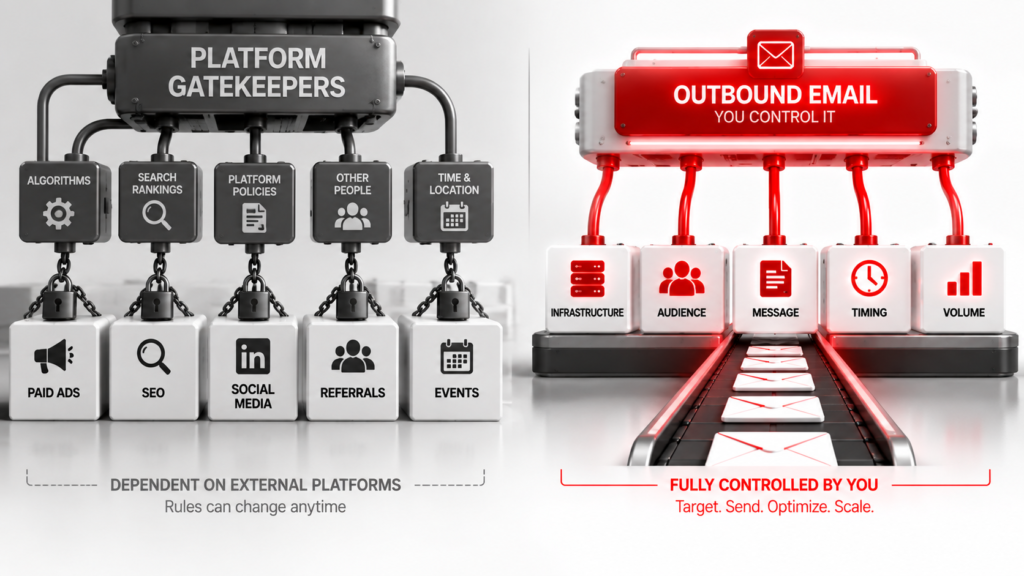
Every B2B marketing and sales channel comes with dependencies. Paid ads depend on platform algorithms and auction dynamics. SEO depends on search engine ranking decisions. Social media depends on feed algorithms and engagement rules set by platforms that can change overnight. Referrals depend on the goodwill and timing of existing clients. Every one of these channels is partially outside the control of the company using it.
Outbound email is different. When it is built and managed correctly, it is the only B2B channel where the targeting, the timing, the message, the volume, and the audience are entirely within the control of the sender.
Table of contents
- What channel control actually means
- How other B2B channels create dependency
- Why outbound email is structurally different
- The elements of outbound email that are fully controllable
- Where outbound email control has limits
- How to build a campaign that maximizes control
- FAQ
What channel control actually means
Channel control is the degree to which a company can determine, independently and without external permission, who sees its message, when they see it, how often, and in what context. Full control means that no platform, algorithm, or third party can unilaterally change the rules in a way that undermines the campaign without warning.
Control matters for a few practical reasons. A channel without control is a channel with hidden risk. A company that builds its entire B2B pipeline on paid ads is one algorithm update away from a significant and sudden drop in lead volume. A company that relies heavily on LinkedIn outreach is subject to connection limits, platform policy changes, and account restrictions that can interrupt campaigns at any point.
A company that builds its pipeline on well-executed outbound email retains the ability to reach its target market regardless of what any external platform decides to do.
How other B2B channels create dependency
Understanding why outbound email is different requires a clear picture of where other channels introduce dependency.
Paid advertising. Ad platforms control targeting options, auction dynamics, cost per click, and the policies that determine what can and cannot be advertised. A policy change, a competitor increasing bids in the same auction, or an algorithm update can increase costs or reduce reach overnight. The company paying for ads has no ability to prevent or appeal these changes.
SEO and content marketing. Search engine ranking is determined by algorithms that change frequently and without notice. A company that has built significant organic traffic can lose a meaningful portion of it after a single algorithm update, with no recourse and no timeline for recovery.
Social media outreach. LinkedIn, the primary B2B social platform, imposes connection request limits, messaging restrictions, and account-level policies that can interrupt or shut down outreach campaigns. Platform policy changes have repeatedly affected how companies can use LinkedIn for B2B prospecting.
Referrals and word of mouth. Referral-based pipeline is valuable but entirely dependent on the timing and initiative of existing clients. It cannot be scheduled, scaled, or directed toward specific target segments in the way an outbound campaign can.
Events and conferences. In-person pipeline generation depends on physical attendance, travel logistics, and the relevance of a particular event’s audience to the target ICP. It is inherently episodic and cannot be run continuously.
Why outbound email is structurally different
Outbound email does not route through a platform that controls who can be reached or on what terms. The sender owns the sending infrastructure. The sender builds the list. The sender writes the message and determines the timing. No intermediary platform decides whether the campaign runs today or tomorrow, or at what cost, or to whom.
This structural difference has real implications for pipeline predictability. A channel that is fully controlled can be planned, budgeted, and scaled with a level of precision that platform-dependent channels cannot match. When a campaign is performing, it can be scaled. When it is underperforming, the specific cause can be diagnosed and addressed without waiting for a platform to explain an algorithm change.
The elements of outbound email that are fully controllable
The audience. The list of prospects a campaign reaches is built from scratch against a defined ICP, verified, and owned entirely by the sender. No platform decides who is in the audience or applies its own targeting logic on top of the sender’s criteria.
The timing. Emails go out when the campaign is scheduled to send them, not when a platform algorithm decides to show them to users. Sending windows, follow-up intervals, and campaign pacing are all determined by the sender.
The message. The subject line, the body copy, the offer, and the call to action are written and controlled entirely by the sender. No algorithm filters, reranks, or deprioritizes the message based on engagement signals from other content competing for the same space.
The volume. Within the constraints of good deliverability practice, the sender determines how many emails go out per day, per week, and per campaign. Scaling up or pulling back is a decision made by the sender, not imposed by a platform.
The infrastructure. The domains, mailboxes, and sending configuration that power the campaign are owned and managed by the sender. No platform can revoke access, change terms of service, or restrict sending capacity without the sender’s direct involvement.
Where outbound email control has limits
Full control over the campaign does not mean full control over every outcome. A few areas where outbound email is subject to external factors:
Mailbox provider filtering. Gmail, Outlook, and other major providers make inbox placement decisions based on sender reputation and content signals. A campaign that generates complaints can see deliverability decline as a consequence of those signals. This is a feedback loop, not an arbitrary platform decision, but it does mean inbox placement is influenced by how the campaign is built and executed, not solely by the sender’s intentions.
Prospect behavior. The decision to reply, ignore, or mark an email as spam is always the prospect’s. Control over the campaign does not translate to control over how individual recipients choose to respond.
Regulatory environment. Outbound email is subject to anti-spam regulations in various jurisdictions, including CAN-SPAM in the United States and GDPR in Europe. These create rules about consent, unsubscribe mechanisms, and data handling that affect how campaigns can be run in certain markets.
These limits are real but they are navigable. Strong research, precise targeting, and relevant messaging address the deliverability risk. Regulatory compliance is manageable with proper setup. The core structural advantage of outbound email, that no platform intermediary controls access to the audience, remains intact regardless of these constraints.
How to build a campaign that maximizes control
Owning the channel means taking full responsibility for every element of it. A campaign that maximizes the structural advantages of outbound email typically does the following:
Builds and owns its own sending infrastructure. Rather than relying on shared platforms that impose limits or change terms, the campaign runs on dedicated domains and mailboxes configured specifically for outbound use.
Builds its own list from ICP-defined criteria. Rather than renting access to an audience through a platform, the list is built fresh against specific targeting criteria and verified before sending begins.
Warms sending infrastructure before any campaign volume goes out. Taking the time to build sender reputation before launching protects the campaign from the deliverability consequences that come with sending cold at volume.
Monitors and manages deliverability actively throughout the campaign. The control advantage of outbound email is only maintained when the campaign is actively managed, not set and forgotten.
Keeps the offer and messaging grounded in current research. A campaign that reaches the right people with a relevant offer generates positive engagement signals that reinforce deliverability and protect the campaign’s ability to keep running.

FAQ
Does owning the channel mean outbound email is risk-free?
No. The risks in outbound email are real, primarily around deliverability and domain reputation, but they are navigable and within the sender’s influence. The risks in platform-dependent channels are often imposed externally and without warning.
Can outbound email replace other B2B channels entirely?
For many B2B companies, outbound email can serve as the primary pipeline generation channel. Whether it replaces other channels entirely depends on the specific market, ICP, and business model. The more relevant point is that it provides pipeline that is independent of any other channel, reducing overall dependency risk.
Is outbound email affected by privacy regulations in the same way paid advertising is?
Both channels operate within a regulatory environment, but the specific rules differ. Outbound email regulations like CAN-SPAM and GDPR are well-established and manageable with proper campaign setup. The regulatory pressure on paid advertising, particularly around cookie-based targeting, has been increasing and is creating meaningful uncertainty for advertisers dependent on those targeting capabilities.
If outbound email is so controllable, why do so many campaigns fail?
Control over the channel does not guarantee correct use of it. Campaigns fail because of poor research, weak offers, bad list quality, and skipped infrastructure setup, not because the channel itself is unreliable. The controllability of outbound email is an advantage that only produces results when the campaign is built correctly.
In a B2B environment where platform algorithms, advertising costs, and social media policies are all subject to change without notice, the ability to reach a precisely defined audience on your own terms and your own timeline is a genuine strategic advantage. Outbound email, built and managed correctly, is the channel that provides it.
Comments are closed.