
Reading time: 9 min
Entering a new B2B market is one of the most resource-intensive things a company can do. Building brand awareness takes months. SEO takes longer. Paid advertising in an unfamiliar market requires significant testing budget before it produces reliable pipeline. Referrals in a market where the company has no existing relationships are not available by definition.
Outbound email is different. A well-built outbound campaign can reach a precisely defined segment of a new market within weeks, generate real conversations with real buyers, and produce validated learning about whether the offer actually resonates, all before any other channel has had time to generate meaningful results.
Table of contents
- Why market entry is a speed problem
- How other channels perform at market entry
- Why outbound email is structurally suited to market entry
- What a market entry outbound campaign looks like
- Using outbound to validate before scaling
- Common market entry mistakes and how to avoid them
- FAQ
Why market entry is a speed problem
Entering a new B2B market involves two parallel challenges: generating pipeline and generating learning. Pipeline is the immediate commercial goal. Learning is what determines whether the market entry strategy is correct, whether the ICP is right, whether the offer resonates, whether the positioning needs adjustment.
The faster both challenges can be addressed, the faster a company can make informed decisions about whether and how to invest more heavily in a new market. A market entry strategy that takes twelve months to generate meaningful signal is twelve months of uncertainty, sunk cost, and opportunity cost relative to a strategy that generates the same signal in six to eight weeks.
Speed in market entry is not just a tactical advantage. It is what determines whether a company can iterate quickly enough to find the right approach before running out of runway, patience, or competitive window.
How other channels perform at market entry
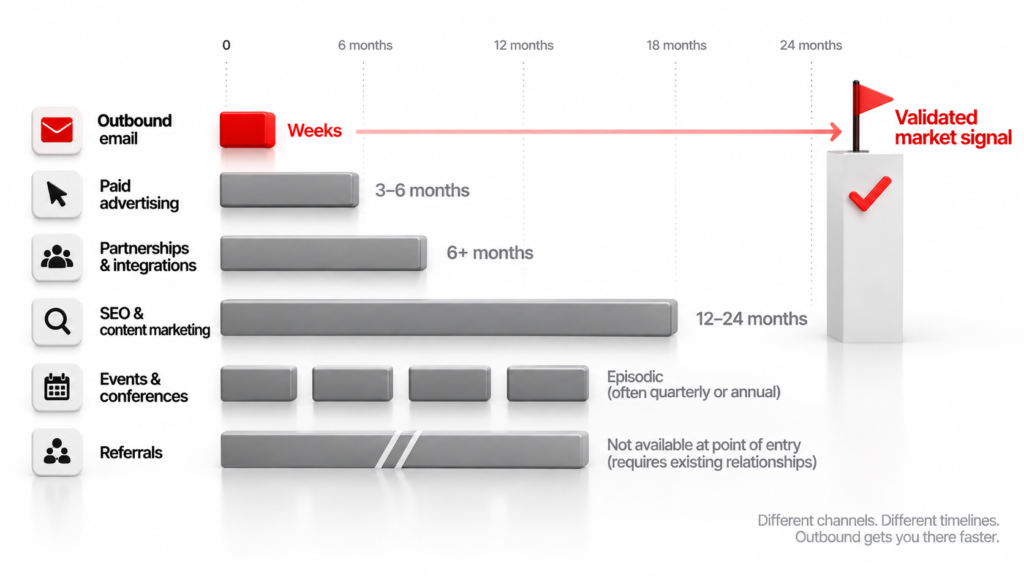
Every major B2B channel has a lag between investment and meaningful signal at market entry. Understanding that lag clarifies why outbound email is in a different category.
Paid advertising. A new market requires new creative, new targeting parameters, and a testing period before the algorithm learns which audiences and placements convert. Meaningful, reliable pipeline from paid ads in a new market typically takes three to six months of iterative testing to establish.
SEO and content marketing. Building search authority in a new market from scratch is a twelve to twenty-four month investment at minimum. Content needs to be created, indexed, and build authority over time before it generates meaningful organic traffic.
Partnerships and integrations. Identifying, negotiating, and activating channel partnerships in a new market is a relationship-building process that rarely produces pipeline in under six months.
Events and conferences. Industry events in a new market are episodic, often quarterly or annual, and require lead time for sponsorship and preparation. A single event rarely generates enough pipeline to validate a market entry hypothesis on its own.
Referrals. By definition, referrals in a new market require existing relationships in that market, which are not available at the point of entry.
None of these channels are wrong for market entry over a longer time horizon. The problem is that at the moment of entry, when validated signal about whether the market opportunity is real is most urgently needed, most of them cannot provide it quickly.
Why outbound email is structurally suited to market entry
Outbound email does not require pre-existing brand awareness, search authority, platform learning periods, or existing relationships in the target market. It requires a defined ICP, a research-driven offer, and properly configured sending infrastructure. All three can be built in weeks rather than months.
The structural advantages that make outbound email particularly effective at market entry:
Direct access to the target market. A precisely built list reaches the specific decision-makers in the new market without requiring any intermediary platform, algorithm, or existing relationship to facilitate the introduction.
Immediate feedback. Replies, both positive and negative, arrive within days of launching a campaign. That feedback is real market signal about whether the offer resonates, what objections exist, and whether the ICP definition was accurate.
Low minimum viable investment. A market entry outbound campaign does not require the budget of a paid advertising test or the time of an SEO build. A focused campaign targeting a few hundred precisely matched prospects can generate meaningful signal with a fraction of the investment other channels require.
Iterability. Because the feedback cycle is short, an outbound campaign can be adjusted based on early results within weeks. An offer that is not landing can be rebuilt from updated research and retested before the window to enter the market has passed.
No dependency on existing market presence. Unlike referrals or inbound channels, outbound email works equally well in a market where the company has no existing reputation. The offer stands or falls on its own merits, not on pre-existing brand recognition.
What a market entry outbound campaign looks like
A well-structured market entry campaign is not a full-scale outbound operation from day one. It is a deliberate, phased approach designed to generate validated signal before scaling investment.
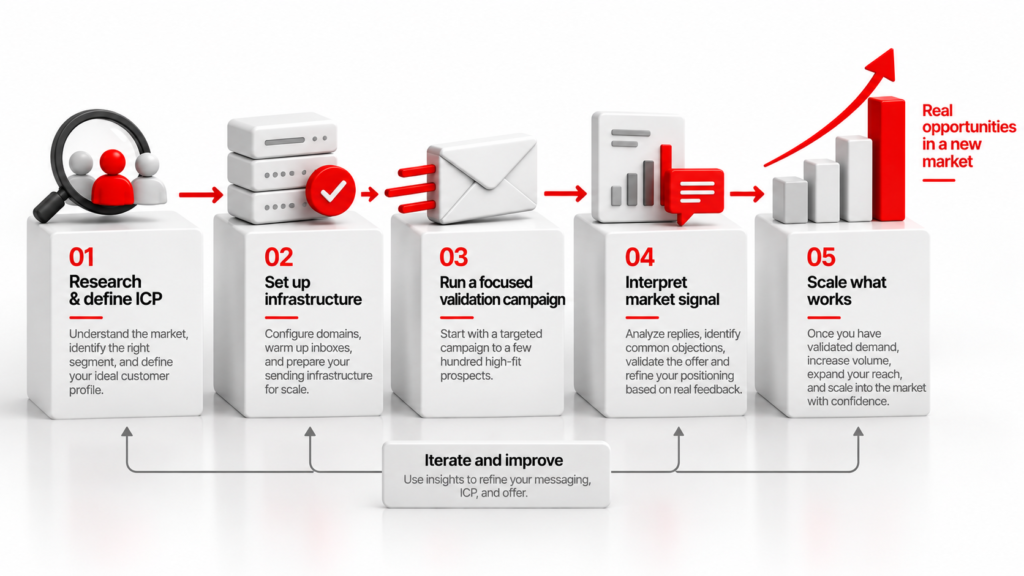
Phase 1: Research and ICP definition
Before building any list or writing any copy, the new market needs to be understood at the buyer persona level. Who are the decision-makers? What are their goals and obstacles in this market specifically? How does the offer map to the problems they are actively trying to solve right now? This research phase is shorter for a market adjacent to one the company already understands, and longer for a genuinely new vertical.
Phase 2: Infrastructure setup and warmup
New markets typically require new sending infrastructure, specifically new domains and mailboxes configured and warmed before any campaign volume goes out. Skipping this step to save time at market entry is a false economy that produces deliverability problems within weeks.
Phase 3: A focused validation campaign
The first campaign in a new market should be deliberately narrow: a small, precisely targeted list, one specific offer, and messaging built entirely on the research from phase one. The goal is not to maximize volume. It is to generate clean signal about whether the offer resonates before scaling.
Phase 4: Signal interpretation and iteration
Replies from the validation campaign, positive, negative, and requests for clarification, all contain information. A high positive reply rate confirms the offer and ICP. A high negative reply rate with consistent objections reveals what needs to change. Silence across a well-targeted list points to a fit or deliverability issue worth diagnosing before increasing volume.
Phase 5: Scaling based on validated signal
Once the validation campaign has confirmed that the offer resonates in the new market, scaling becomes a matter of expanding the list, refining the messaging based on early learnings, and increasing sending volume in line with what the infrastructure can support.
Using outbound to validate before scaling
One of the least appreciated advantages of outbound email at market entry is its value as a validation tool before significant investment is made in other channels.
A company considering entering a new vertical can run a focused outbound campaign targeting a hundred to two hundred precisely matched prospects, measure the reply rate and the quality of the conversations generated, and use that data to make an informed decision about whether to invest in building SEO, paid advertising, or a dedicated sales function for that market.
The alternative is committing to a twelve-month inbound strategy in a market that turns out not to have the problem the company thought it did. Outbound email generates the signal that prevents that kind of expensive misdirection.
Common market entry mistakes and how to avoid them
Reusing existing campaign assets in the new market. Copy, offers, and list criteria built for one market rarely transfer directly to another. Buyer personas, language, and pain points differ enough across industries and geographies that market entry requires its own research and build, not a repurposed version of what worked elsewhere.
Scaling before validating. The temptation to launch at full volume immediately is strong, especially when there is commercial pressure to show results quickly. A campaign that scales before the offer is validated risks burning sending infrastructure on a message that does not resonate, creating deliverability problems that outlast the original campaign.
Skipping warmup to save time. New infrastructure for a new market needs to be warmed before campaign volume goes out. The time saved by skipping warmup is quickly lost when deliverability problems emerge and the campaign has to be paused to recover.
Treating silence as failure rather than signal. A campaign that generates low reply rates in a new market is telling something important. Either the ICP is wrong, the offer is not relevant, or the messaging is not connecting the two effectively. That signal is more valuable than silence from a channel that has not yet generated any feedback.
Underinvesting in research for an unfamiliar market. The temptation to rely on assumptions about a new market is strongest precisely when the company has the least existing knowledge about it. A market entry campaign built on assumptions rather than research produces results that reflect the quality of those assumptions, not the actual opportunity in the market.
FAQ
How long does it take to launch a market entry outbound campaign?
With proper research, ICP definition, infrastructure setup, and warmup, a focused market entry campaign can be ready to launch in three to five weeks. Skipping any of these steps reduces that timeline but also reduces the campaign’s chances of generating meaningful signal.
How many prospects should a market entry validation campaign target?
A validation campaign targeting one hundred to three hundred precisely matched prospects is typically sufficient to generate meaningful signal without overcommitting resources before the offer is confirmed. Larger initial campaigns add volume without adding proportionally more learning.
What reply rate from a validation campaign suggests the market is worth pursuing further?
A positive reply rate above 3% from a precisely targeted validation campaign is generally a strong signal that the offer resonates and the market is worth pursuing. Lower rates warrant investigation before scaling, while rates consistently above 5% suggest strong fit worth investing in aggressively.
Can outbound email be the only channel used for market entry?
For many B2B companies, particularly those entering adjacent markets or targeting defined niches, outbound email alone can generate enough pipeline to make an informed market entry decision and build initial revenue. Whether it remains the only channel over time depends on the scale of the opportunity and the resources available to invest in complementary channels once the market entry hypothesis is validated.
Entering a new B2B market requires speed, precision, and validated learning before significant resources are committed. Outbound email, built correctly, delivers all three faster than any other channel available to a B2B company at the moment of market entry.
Comments are closed.