
Reading time: 9 min
Customer development research is the step most outbound campaigns skip entirely. It takes time, it requires real conversations and real data, and its impact is not immediately visible in a dashboard. The results show up later, in reply rates that hold steady over time, in offers that prospects actually want, and in campaigns that do not burn out after a few weeks of sending.
Every other element of an outbound campaign, the list, the infrastructure, the copy, the offer, is only as strong as the research that shaped it. Skip the research and every subsequent step is built on assumptions dressed up as strategy.
Table of contents
- What customer development research actually is
- Why it matters more than any other single campaign input
- The four questions customer development research answers
- Where to find real customer development data
- How research shapes each element of the campaign
- What happens when research is skipped
- FAQ
What customer development research actually is
Customer development research is the process of deeply understanding the people a campaign is trying to reach, before any campaign decisions are made. It goes significantly beyond defining a job title or an industry. It is an investigation into how the target buyer thinks, what they are trying to accomplish, what is standing in their way, and what would make a cold email from an unfamiliar sender worth their time.
The term comes from the startup world, where customer development refers to the process of validating assumptions about a market before building a product. In outbound email, the same principle applies. Campaigns built on validated understanding of the buyer consistently outperform campaigns built on internal assumptions, for the same reason that products built on real customer insight consistently outperform products built on guesswork.
Why it matters more than any other single campaign input
Every element of an outbound campaign that matters, the offer, the messaging, the list criteria, the lead magnet, is downstream of customer development research. Change the research and everything changes. Skip the research and everything weakens simultaneously.
Consider what research actually determines:
- The offer. An offer that addresses a problem the buyer is actively trying to solve is built from research. An offer that addresses a problem the seller assumes the buyer has is built from guesswork.
- The messaging. Copy that speaks in the buyer’s own language about the buyer’s own situation is built from research. Copy that sounds like a generic pitch is what happens without it.
- The list criteria. A list built around specific firmographic and situational signals of genuine fit is built from research. A list built from broad category filters is what happens without it.
- The lead magnet. A lead magnet so precisely relevant to the buyer’s situation that refusing it feels like a mistake is built from research. A generic checklist or recycled report is what happens without it.
Research is not one input among many. It is the input that all other inputs depend on.

The four questions customer development research answers
A thorough customer development process answers four core questions about the target buyer persona. These are the questions that, once answered with real evidence rather than assumptions, make every subsequent campaign decision significantly clearer.
1. What is the buyer trying to accomplish?
Not in the abstract, not in the language of the seller’s value proposition, but in the specific, concrete terms of what success looks like for this person in their current role. A VP of Sales trying to hit a number by end of quarter has a different immediate priority than a VP of Sales trying to rebuild a team after a round of layoffs. Same title, completely different situation.
2. What is standing in their way?
The obstacle between the buyer and their goal is where the most useful research insight lives. Obstacles are specific. They are operational, resource-based, political, or technical. An offer that directly addresses a real, specific obstacle lands completely differently than one addressing a generalized challenge.
3. What has already been tried?
Understanding what solutions the buyer has already attempted, and why those have not fully solved the problem, reveals the specific gap the offer needs to fill. It also surfaces objections before they come up in a reply, making it possible to preempt them in the messaging.
4. What would make them act now?
Not eventually, not in principle, but now. This question surfaces the buying triggers that create urgency, the specific circumstances that move a buyer from passive interest to active consideration. An offer timed to a known trigger consistently outperforms one sent without regard to where the buyer is in their own decision cycle.
Where to find real customer development data
The most common mistake in customer development research is relying on internal assumptions rather than external evidence. A few sources that consistently produce reliable, actionable insight:
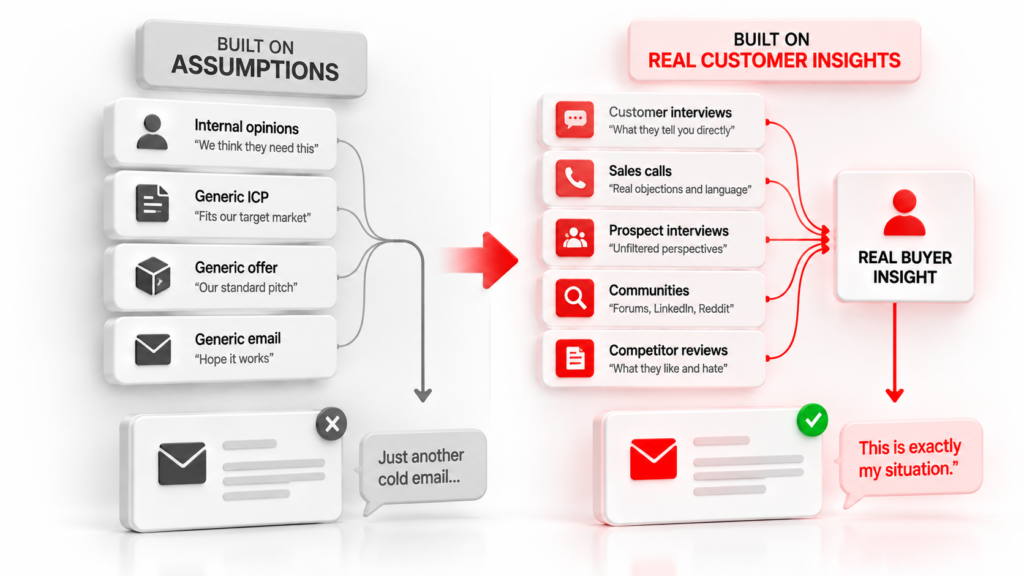
Existing clients. Conversations with current clients who match the target persona are the single most valuable research source available. They have already made the decision to buy, which means they can speak directly to what motivated them, what they had already tried, and what specifically made the offer worth acting on.
Sales call recordings and notes. Every sales conversation contains buyer language, real objections, and real descriptions of the problem being solved. A systematic review of call recordings often surfaces patterns that are invisible when looking at any individual conversation.
Prospect interviews. Direct conversations with people who match the target persona but have not yet bought produce insight into how the problem is perceived from the outside, without the confirmation bias that can affect conversations with existing clients.
Industry communities and forums. Spaces where the target persona discusses their work in their own words, unfiltered by a sales conversation, are a rich source of authentic language and real, current pain points.
Competitor positioning and reviews. How competitors describe the problem, and how clients of competitors describe their experience in reviews, reveals how the market as a whole is thinking about the challenge being addressed.
How research shapes each element of the campaign
Customer development research does not just inform the strategy document. It changes the specific words, criteria, and decisions made across every element of the campaign.
The ICP and list criteria. Research reveals which specific types of companies and roles have the problem most acutely, at what stage, and under what circumstances. This precision is not achievable from demographic data alone.
The lead magnet. A lead magnet built from research addresses one specific obstacle, in one specific situation, in language the buyer actually uses. It does not require the prospect to translate it into their own world because it is already there.
The email copy. Research provides the specific language, the exact pain point framing, and the buying trigger context that makes an email feel personally relevant rather than generically targeted. The difference between a prospect thinking “this is exactly my situation” and thinking “another cold email” almost always comes down to whether research shaped the copy.
The offer framing. Research reveals how the buyer thinks about the problem being solved, which determines how the offer should be framed: around cost, speed, risk reduction, competitive advantage, or something else entirely depending on what the buyer actually cares most about.
The follow-up sequence. Understanding the buyer’s decision process, including how long decisions typically take and what objections come up most often, allows the follow-up sequence to be structured around that reality rather than a generic timeline.
What happens when research is skipped
Skipping customer development research does not produce a bad campaign immediately. It produces a campaign that looks like it might work, runs for a few weeks, generates some early replies from the small percentage of prospects where the generic offer accidentally lands on a real pain point, and then plateaus.
The plateau is the structural consequence of guesswork. Without research, the offer cannot be precise enough to consistently resonate. Without precision, only the prospects who happen to have exactly the problem the offer addresses will respond, and that percentage is always small relative to the full list.
The other consequence of skipping research is domain burnout. A campaign that reaches prospects with an offer that is not relevant to them generates complaints. Those complaints accumulate against the sending domain. Eventually the domain gets flagged by major email service providers and stops delivering to inboxes reliably. The research that would have made the offer relevant enough to avoid those complaints also would have protected the infrastructure the campaign depends on.
Research is not just a strategy investment. It is a deliverability investment.
FAQ
How long does customer development research take before a campaign can launch?
This depends on the depth of existing knowledge about the target persona and the availability of research sources. For a market where significant client and sales conversation data already exists, a focused research phase of one to two weeks is often sufficient. For a new market or persona with limited existing data, a longer research phase that includes direct prospect interviews produces a stronger foundation.
Can customer development research be done once and reused across multiple campaigns?
Research insights have a shelf life. Buyer priorities, market conditions, and competitive dynamics shift over time. Research that accurately reflects a persona’s situation today may be partially outdated in six to twelve months. Ongoing campaigns benefit from periodic research refreshes rather than relying permanently on initial findings.
What if there are no existing clients to interview for research?
When existing client data is not available, prospect interviews and analysis of competitor reviews and community discussions become the primary research sources. It takes more effort, but the same questions can be answered through external research when internal data does not exist.
Is customer development research the same as market research?
They overlap but are not identical. Market research tends to focus on market size, trends, and competitive landscape at a macro level. Customer development research focuses specifically on the individual buyer: their goals, obstacles, language, and buying triggers. Both are useful, but for outbound email campaign decisions, customer development research produces more directly actionable insight.
A campaign launched without customer development research is a campaign launched on hope. A campaign launched with it is a campaign launched on evidence. The difference shows up in every reply rate, every lead magnet conversion, and every domain that does not burn out after six weeks of sending.
Comments are closed.