
Reading time: 9 min
A 1% reply rate and a 10% reply rate can look like they come from the same place: both are outbound email campaigns, both have subject lines and follow-up sequences, both are sending to a list of B2B prospects. But the gap between them is not a matter of degree. It is a structural difference in how the campaign was built from the very beginning.
Understanding what actually drives that gap is the difference between running campaigns that generate occasional replies and running campaigns that consistently book meetings and close deals.
Table of contents
- What reply rate actually measures
- Why most campaigns plateau at 1% to 2%
- The five variables that separate high-performing campaigns
- How targeting precision affects reply rate
- How offer relevance affects reply rate
- How messaging specificity affects reply rate
- How infrastructure and deliverability affect reply rate
- How follow-up sequence quality affects reply rate
- FAQ
What reply rate actually measures
Reply rate is the percentage of prospects who respond to a campaign, out of the total number contacted. It is the primary measure of outbound email performance because it is the only metric that directly reflects whether the campaign is achieving its purpose: starting real conversations with real potential buyers.
A reply is not just a positive signal. Negative replies, objections, and requests to be removed from a list are all replies. What matters for campaign diagnosis is the ratio of positive replies, genuine interest or requests for more information, to total replies. A campaign generating a 5% reply rate where half the replies are negative is performing very differently from a campaign generating a 3% reply rate where nearly all replies are positive.
Why most campaigns plateau at 1% to 2%
The majority of outbound email campaigns plateau at reply rates between 1% and 2%. This range is not a performance ceiling. It is the predictable result of a specific set of structural decisions made during campaign setup.
Campaigns in this range share common characteristics:
- Lists built from broad demographic filters rather than precise ICP criteria
- Offers framed around the sender’s product or service rather than the prospect’s specific problem
- Copy that sounds like a template even when it technically includes personalization tokens
- Infrastructure set up once and not actively monitored or managed
- Follow-up sequences that nudge rather than add new value with each touchpoint
None of these are catastrophic failures individually. Together, they produce a campaign that reaches the right general category of person with a message that is relevant to some of them some of the time, which produces reply rates that reflect exactly that level of precision.
The five variables that separate high-performing campaigns
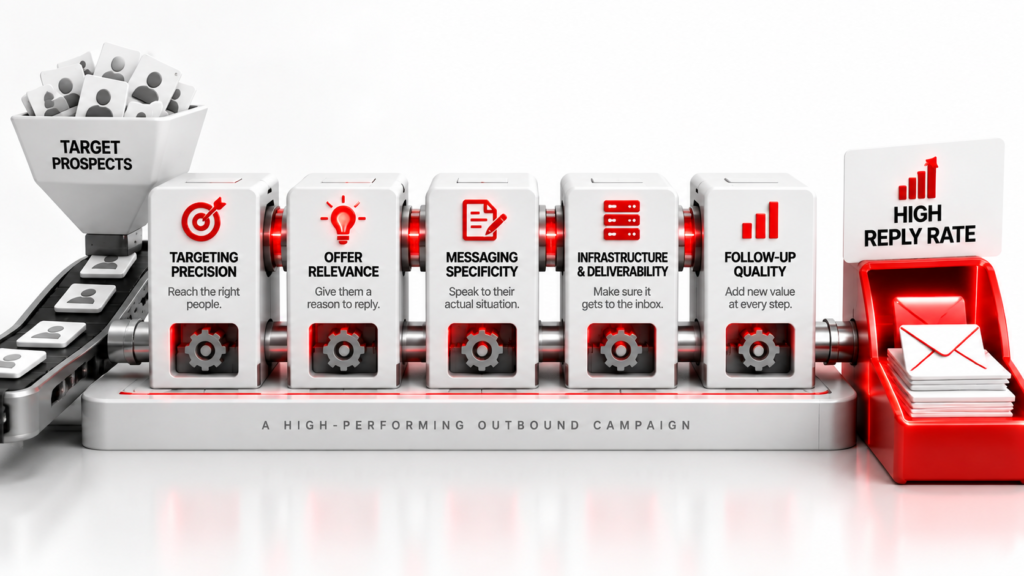
Campaigns that consistently achieve reply rates in the 5% to 10% range are built differently across five specific variables: targeting precision, offer relevance, messaging specificity, infrastructure quality, and follow-up sequence design. Each one contributes independently, and the combination of all five is what produces consistently high performance.
How targeting precision affects reply rate
Targeting is the first variable because it determines the ceiling for every other element. A campaign that reaches the wrong people cannot be rescued by good copy or a strong offer. The best possible outcome from a poorly targeted campaign is a reply rate that reflects the small percentage of contacts who happen to be a good fit despite the imprecise targeting.
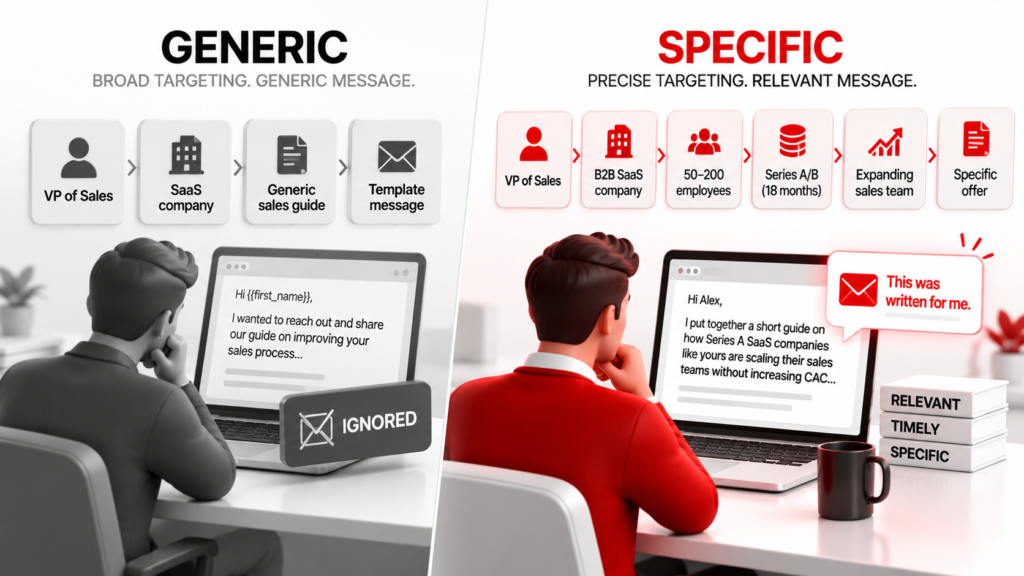
High-performing campaigns target at a level of specificity that most teams treat as unnecessarily narrow. Rather than “VP of Sales at SaaS companies with 50 to 500 employees,” a precisely targeted campaign might specify “VP of Sales at B2B SaaS companies with 50 to 200 employees that have raised a Series A or B in the last 18 months and are currently expanding their sales team.”
That level of specificity does three things simultaneously. It reduces the list to contacts where the offer is most likely to be immediately relevant. It enables messaging that references the prospect’s actual current situation. And it dramatically reduces the percentage of contacts who receive the email and find it irrelevant, which protects deliverability and keeps the campaign running effectively over time.
How offer relevance affects reply rate
The offer is what the prospect is being asked to consider. In outbound email, the offer is not always a product or service directly. It is frequently a lead magnet, a piece of value that earns the conversation before asking for anything in return.
The difference between a 1% reply rate offer and a 10% reply rate offer is specificity. A generic offer asks the prospect to evaluate whether it might be relevant to them. A specific offer, built around a documented pain point for a precisely defined persona, makes that evaluation instant and obvious.
Consider the difference between offering “a guide to improving your sales process” and offering “a breakdown of the three reasons B2B SaaS companies at your growth stage see pipeline drop in Q3, and how the ones that don’t are structuring their outbound differently.” The second offer requires research to create. It also requires almost no effort from the prospect to recognize as relevant, which is why it converts at a fundamentally different rate.
How messaging specificity affects reply rate
Personalization tokens, inserting a company name or job title into a template, are not the same as specific messaging. High-reply-rate campaigns are not more personalized in the technical sense. They are more specific in the substantive sense: the message reflects a genuine understanding of the prospect’s situation that could not have been arrived at without research.
Specific messaging shows up in a few distinct ways:
- The opening line references something true and current about the prospect’s situation, not a generic observation that could apply to anyone in their industry
- The problem being addressed is described in language the prospect actually uses, not internal jargon or generic category terms
- The offer is framed around the outcome the prospect cares about, not the features of the product or service being promoted
- The call to action is specific and low-friction, making the next step obvious and easy to take
The goal is for the prospect to read the email and think “this was written for me,” even if it was sent as part of a campaign. That reaction is only possible when the messaging is grounded in real research about the specific persona being targeted.
How infrastructure and deliverability affect reply rate
Deliverability determines what percentage of sent emails actually reach the inbox. A campaign with strong targeting, a compelling offer, and specific messaging that lands in spam folders will always produce reply rates that look like a targeting or messaging failure, because the emails are never seen.
The infrastructure variables that most directly affect whether a campaign can achieve high reply rates are:
- Domain warmup. A campaign sent from a domain that has not been properly warmed will face inbox placement challenges from the first send, suppressing reply rates before the offer or copy has any chance to perform.
- Sending volume management. Sending too much volume too quickly, particularly from a relatively new domain, triggers filtering that reduces inbox placement. High-performing campaigns scale volume gradually and monitor placement actively.
- Content relevance as a deliverability signal. An email that is highly relevant to its recipient generates positive engagement signals that reinforce sender reputation. An email that generates complaints or is consistently ignored generates negative signals that suppress future deliverability. High reply rates and strong deliverability reinforce each other when the campaign is built correctly.
How follow-up sequence quality affects reply rate
Most B2B buyers do not reply to the first email in a sequence, even when the offer is relevant and the timing is right. They are busy, the email arrives at a moment when they cannot act on it, or they need one more touchpoint before the offer feels worth responding to.
Follow-up sequences that contribute to high reply rates are not repetitive nudges. Each touchpoint adds something new: a different angle on the same offer, a piece of supporting evidence, a case study relevant to the prospect’s situation, or a reframing of the original message that makes the value more immediately obvious.
The sequences that suppress reply rates are the ones that send variations of “just checking in” or “wanted to follow up on my previous email.” These sequences train prospects to ignore subsequent emails because each one delivers no additional reason to respond.
A high-performing follow-up sequence treats each touchpoint as a fresh opportunity to demonstrate relevance, not a reminder that the prospect has not yet replied.
FAQ
Is a 10% reply rate realistic for most B2B outbound campaigns?
For campaigns built with precise targeting, a research-driven offer, and specific messaging, reply rates in the 5% to 10% range are achievable. Campaigns targeting a very narrow, highly specific segment with a precisely matched offer sometimes exceed this range. Campaigns built on broader targeting and generic offers consistently land in the 1% to 2% range regardless of how much the copy is optimized.
Does reply rate vary significantly by industry or ICP?
Yes. Some industries and buyer personas are more responsive to outbound email than others, based on factors like how frequently they receive outbound outreach, how pressing the problem being solved is in their current context, and how competitive the outbound landscape is in their specific niche. Benchmarking against the specific market being targeted is more meaningful than comparing against a universal average.
Should negative replies be counted in reply rate calculations?
Yes, because reply rate measures campaign reach and resonance, not just positive outcomes. That said, tracking positive reply rate separately from total reply rate gives a more complete picture of campaign quality. A high total reply rate with a low positive reply rate suggests the offer is generating engagement but not genuine interest.
Can a campaign move from a 1% to a 10% reply rate through copy optimization alone?
Rarely. Copy optimization can improve performance at the margin, but the gap between 1% and 10% almost always reflects structural differences in targeting precision and offer relevance that copy alone cannot bridge. The campaigns that make that jump typically rebuild from the research stage rather than iterating on existing templates.
The gap between a 1% reply rate and a 10% reply rate is not a mystery. It is the measurable difference between a campaign built on assumptions and a campaign built on research. Every variable that separates high-performing campaigns from average ones traces back to the same root: knowing the prospect’s situation well enough to make an offer they actually want to respond to.
Comments are closed.