
Reading time: 9 min
Product-market fit is one of those terms that gets used constantly in startup and B2B circles without much precision about what it actually means in practice. In the context of outbound email, it means something very specific: whether the offer being made in a campaign matches a real, active need in the market being targeted. Without that match, no amount of technical setup, copywriting skill, or sending volume will produce consistent results.
Table of contents
- What product-market fit actually means
- How product-market fit shows up in outbound email performance
- The difference between a fit problem and a messaging problem
- How to test for product-market fit through outbound
- What poor product-market fit looks like in campaign data
- How to improve fit before relaunching a campaign
- FAQ
What product-market fit actually means
Product-market fit, in its simplest form, is the degree to which a product or service solves a real problem for a specific group of people who are actively looking for that solution. It is not about having a great product in the abstract. It is about whether the right people recognize the problem being solved as their problem, and whether the solution being offered feels like a genuine answer to it.
In outbound email specifically, product-market fit has a practical definition: does the offer in the email address something the recipient is actually trying to solve right now, in terms they recognize, with a solution that feels credible? If yes, replies follow. If not, they do not, regardless of how well the email is written.
This is why product-market fit sits upstream of every other campaign variable. Copy, targeting, infrastructure, and deliverability all matter. But none of them can compensate for an offer that the market does not actually want.
How product-market fit shows up in outbound email performance
The clearest signal of strong product-market fit in an outbound campaign is a consistent pattern of positive replies that require minimal persuasion. When fit is strong, prospects respond because the offer speaks directly to something they are already thinking about. The email does not need to convince them they have a problem. It just needs to show up at the right moment with the right solution.
Conversely, the clearest signal of weak product-market fit is a consistent pattern of silence or polite disinterest across a well-targeted, well-executed campaign. When a campaign is reaching the right people, the infrastructure is solid, the copy is strong, and reply rates are still consistently low, the problem is almost always in the offer itself, not in the execution around it.
The difference between a fit problem and a messaging problem
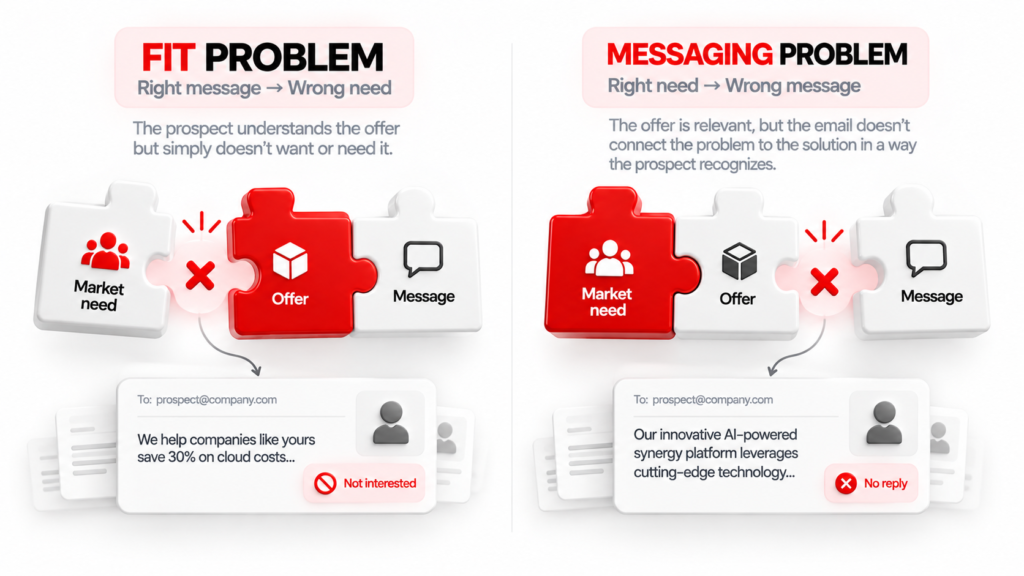
These two problems can look identical on the surface, since both produce low reply rates. Distinguishing between them matters because the fix is completely different.
A messaging problem means the offer is right but the way it is being communicated is wrong. The prospect has the problem being solved, but the email is not connecting that problem to the solution in a way they recognize. The fix is to go back to research, understand how the prospect describes their own problem, and rebuild the messaging around their language rather than internal assumptions.
A fit problem means the offer itself does not match what the market actually needs. Even if the messaging were perfect, the reply would be no, because the prospect either does not have the problem being addressed or does not see it as a priority worth solving right now.
A practical way to distinguish between the two: if a campaign is generating occasional positive replies from a subset of prospects but silence from the majority, it is likely a targeting or messaging problem. If a campaign is generating near-universal silence or polite declines across an otherwise well-targeted list, it is likely a fit problem.
How to test for product-market fit through outbound
Outbound email is actually one of the most efficient ways to test product-market fit quickly, without requiring a large audience or a long feedback cycle. A small, precisely targeted campaign can generate meaningful signal about whether an offer resonates within weeks rather than months.
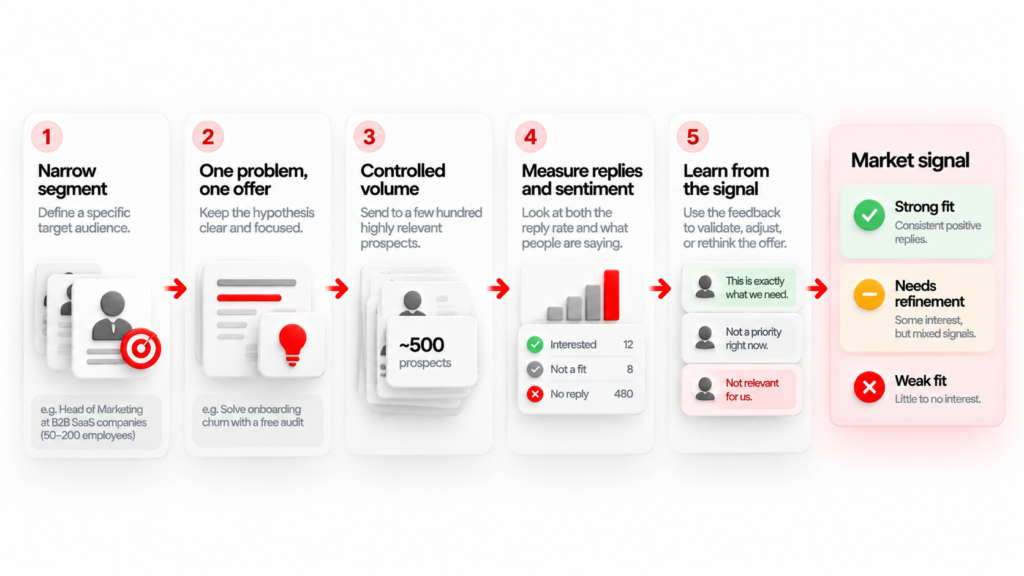
A structured fit test through outbound looks like this:
- Define a narrow, specific target segment. The more precisely defined the segment, the cleaner the signal. A broad campaign targeting everyone who might theoretically benefit from a product produces noise, not signal.
- Build an offer around one specific problem. Do not try to test multiple value propositions in the same campaign. Each email should make one clear offer tied to one specific pain point, so the response data is interpretable.
- Send to a meaningful but controlled volume. A few hundred precisely targeted prospects is enough to generate statistically useful signal without committing significant resources to an unproven offer.
- Measure reply rate and reply sentiment, not just quantity. A 5% reply rate full of “not interested” responses tells a different story than a 2% reply rate where every responder asks for a follow-up call. Sentiment matters as much as volume.
- Treat the replies as research, not just pipeline. Every response, positive or negative, contains information about how the market perceives the offer. Negative responses that explain why are often more useful than positive ones that just agree to a meeting.
What poor product-market fit looks like in campaign data
A few specific patterns in campaign data tend to signal a fit problem rather than a messaging or execution problem:
- Consistent, near-universal silence. A well-targeted campaign with strong infrastructure and decent copy that still generates reply rates below 1% across multiple sends is almost always signaling a fit issue.
- Polite but consistent declines. Responses that say “not the right time,” “we handle this internally,” or “not something we are focused on right now” across a wide range of prospects suggest the problem being solved is not currently a priority for the market.
- Confusion about the offer. Replies asking what the product or service actually does, even after a clear email, often indicate that the problem being solved does not map to anything the prospect recognizes as a real problem in their world.
- Strong performance in one micro-segment but not others. If a campaign performs well with one specific type of company or role but generates silence everywhere else, fit may exist in that narrow segment but not in the broader market being targeted.
How to improve fit before relaunching a campaign
If campaign data is pointing to a fit problem, the fix is not a better email. It is a better offer, built on a clearer understanding of what the market actually needs.
Steps to take:
- Talk to the prospects who did respond, positively or negatively. Direct conversations reveal what the market actually cares about far more reliably than assumptions built from internal brainstorming.
- Narrow the target segment rather than broadening it. A fit problem often hides behind targeting that is too broad. Narrowing to the specific type of company or role where the offer resonates most strongly allows the campaign to build on real signal rather than average it out.
- Reframe the offer around the outcome, not the product. Prospects respond to solutions to problems they recognize, not descriptions of features or services. If the current offer is product-centric, reframing it around the specific outcome it produces for a specific persona often improves resonance significantly.
- Test a different pain point with the same audience. If the current offer is not landing, try a different angle on the same target segment before concluding that the segment itself is wrong. Sometimes fit exists but the campaign has been leading with the wrong problem.
- Validate the ICP before rebuilding the campaign. If the segment being targeted does not actually have the problem being solved at sufficient scale or urgency, no amount of messaging refinement will produce consistent results. Confirming that the problem is real and actively felt in the target market is worth doing before investing in a rebuilt campaign.
FAQ
Can a campaign succeed without strong product-market fit?
Occasionally, in the short term, if the targeting and messaging are exceptionally precise. But consistent, scalable outbound performance requires a genuine match between the offer and a real market need. Campaigns built on weak fit tend to produce unpredictable, unsustainable results even when they do generate some replies.
How do you know if low reply rates are a fit problem or a deliverability problem?
If emails are reaching inboxes and reply rates are still consistently low across a well-targeted list, the problem is almost certainly in the offer or messaging rather than deliverability. A deliverability problem typically shows up as a sudden decline rather than a persistent plateau at a low level.
Is product-market fit fixed once it is established?
No. Market needs shift with economic conditions, competitive dynamics, and changes in how buyers approach problems. A campaign with strong fit today can drift out of alignment over months if the offer is not periodically revisited against current market reality.
Can outbound email be used to find product-market fit, or only to exploit it?
Both. A well-structured outbound test campaign is one of the fastest ways to generate signal about whether an offer resonates in a specific market, making it a useful tool for fit discovery as well as fit exploitation.
Product-market fit is not a box to check before launching a campaign. It is the foundation the campaign is built on, and the lens through which every piece of performance data should be interpreted.
Comments are closed.