
Reading time: 9 min
Most teams building outbound email campaigns spend significant time on copy, offer development, and technical setup. The list often gets the least attention, treated as a data task to be completed quickly before the “real” campaign work begins. This is a mistake that compounds over time. A bad list does not just produce poor results. It actively damages the infrastructure that future campaigns depend on.
Table of contents
- What makes a list bad
- The real cost of sending to a bad list
- Why bought lists almost always underperform
- What a good outbound list actually looks like
- How to build a list worth sending to
- List hygiene and ongoing maintenance
- FAQ
What makes a list bad
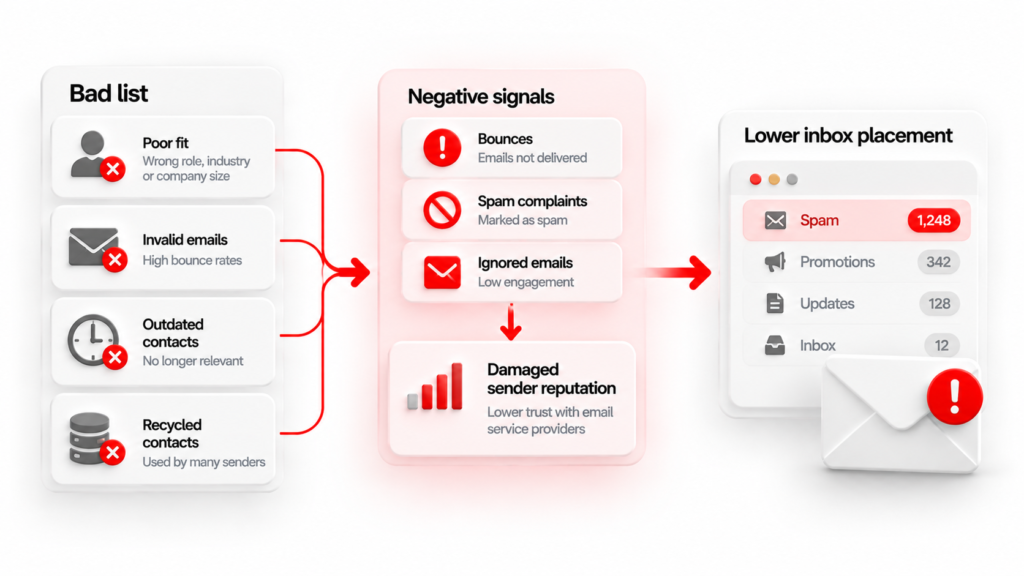
A bad outbound list is not just one with wrong email addresses. It is any list where a significant portion of the contacts are a poor fit for the offer being made. That includes:
- Contacts who do not match the buyer persona. Wrong job title, wrong seniority level, wrong company size, wrong industry, or wrong geography relative to the defined ICP.
- Unverified email addresses. Contacts whose email addresses have not been checked for deliverability, leading to high bounce rates that damage sender reputation.
- Outdated contacts. People who have changed roles, left companies, or whose situations have shifted enough that they are no longer relevant prospects for the current offer.
- Recycled or purchased contacts. Contacts sourced from generic databases that have been sold to and used by multiple senders, often repeatedly, making them less responsive and more likely to mark unfamiliar emails as spam.
- Contacts added without ICP validation. Contacts scraped or added in bulk without being checked against the ideal customer profile criteria that define who the campaign is actually targeting.
Any one of these problems reduces the effectiveness of a campaign. Several of them together can burn a sending domain and derail future campaigns before they even launch.
The real cost of sending to a bad list
The surface-level cost of a bad list is obvious: low reply rates and wasted campaign budget. But the deeper cost is what a bad list does to sending infrastructure over time.
When emails land with large numbers of contacts who are not a good fit, those contacts are significantly more likely to ignore the email, delete it without reading, or mark it as spam. Each of these signals feeds back into the sending domain’s reputation score with major email service providers. Enough negative signals accumulate over time and the domain gets flagged, filtered, or blacklisted. At that point, emails from that domain stop reaching inboxes reliably, regardless of how relevant or well written they are.
The cost of a burned domain is not just the immediate campaign. It is the cost of setting up and warming fresh infrastructure, rebuilding the sending environment from scratch, and the time lost while that new infrastructure establishes a clean reputation. That process takes weeks and represents a significant loss of momentum and campaign capacity.
A bad list does not just produce a bad campaign. It creates a problem that outlasts the campaign itself.
Why bought lists almost always underperform
Purchased lists are a persistent temptation in outbound email because they offer the appearance of scale without the effort of research. The reality is consistently disappointing, for a few structural reasons.
They are not exclusive. A contact database sold to one buyer is typically sold to dozens or hundreds of others. The same prospects have already received outbound emails from multiple other senders using the same list, making them more resistant to cold outreach in general and more likely to treat any unfamiliar email as unwanted.
They are not current. People change jobs, get promoted, leave companies, and shift roles constantly. A contact database built even six months ago contains a meaningful percentage of contacts whose information is no longer accurate, leading to bounces and mismatched targeting.
They are not built around your ICP. A generic contact database is built to appeal to as many buyers as possible, not to match the specific ideal customer profile of any one campaign. The filtering that happens after purchase rarely produces the precision that building a list from scratch against a defined ICP does.
They damage deliverability before the campaign even starts. A list with a high percentage of outdated or irrelevant contacts will produce elevated bounce rates and complaint signals from the first send, starting the damage to sender reputation immediately.
What a good outbound list actually looks like
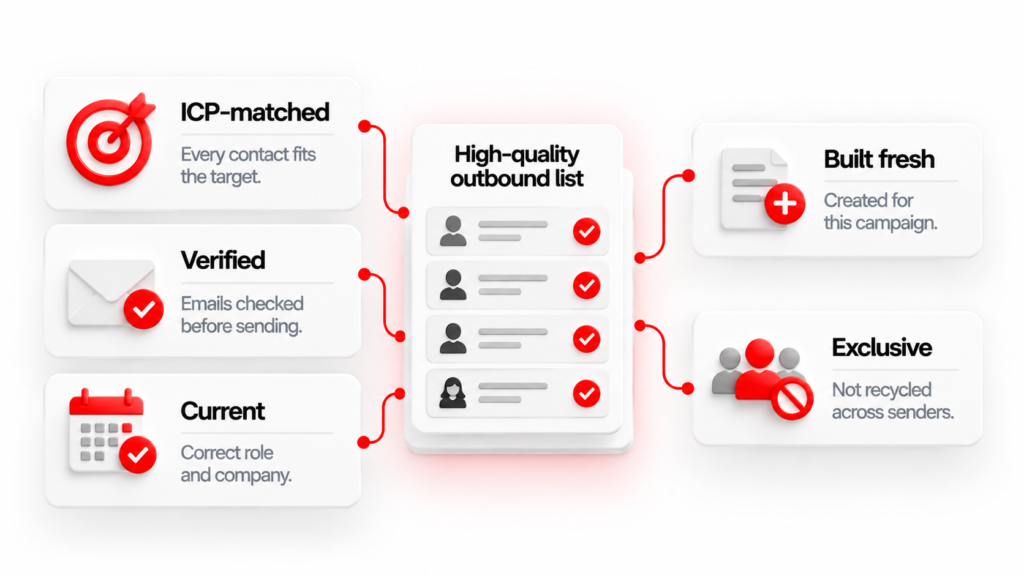
A list worth sending to shares a few consistent characteristics regardless of the industry or market being targeted:
- Every contact matches the defined ICP. Not approximately, not close enough. Every contact has been evaluated against the specific criteria that define the ideal customer, including job title, seniority, company size, industry, and any other relevant firmographic or technographic signals.
- All email addresses have been verified. Verification confirms that an address exists and is likely to accept mail, reducing bounce rates before the first send.
- Contacts are current. The list reflects the prospect’s current role and company, not where they were six or twelve months ago.
- It is built fresh for the campaign. The list is assembled specifically for the current offer and target persona, not reused from a previous campaign with a different focus.
- It is exclusive. The contacts have not been sourced from a shared database being used simultaneously by other senders.
How to build a list worth sending to
Building a high-quality outbound list is a research exercise as much as a data exercise. It starts with a clearly defined buyer persona and ICP, and works outward from there.
Start with a precise ICP definition. Before building any list, confirm exactly who the campaign is targeting. This means specific job titles, seniority levels, company size ranges, industries, geographies, and any other signals that distinguish a strong fit from a weak one.
Use multiple data sources, not just one. No single data source is complete or fully current. Cross-referencing across multiple sources improves accuracy and reduces the risk of building a list entirely on outdated or incomplete data.
Apply ICP filters before adding any contact. Every prospect should be evaluated against the ICP criteria before being added to the list, not after. Adding first and filtering later produces a less precise list and wastes verification resources on contacts that should never have been included.
Verify every email address before the campaign launches. Email verification removes addresses that are invalid, inactive, or likely to bounce, protecting sender reputation from the first send.
Keep the list size appropriate to the target market. A list of 500 precisely matched, verified contacts will consistently outperform a list of 5,000 loosely matched ones. Volume without precision is not an advantage in outbound email.
Document the sourcing and filtering criteria. Knowing exactly how a list was built makes it easier to identify where problems came from if performance is unexpectedly low, and makes rebuilding or expanding the list more straightforward.
List hygiene and ongoing maintenance
A list that is accurate at the time of building will naturally degrade over time as contacts change roles, leave companies, and shift responsibilities. For campaigns running over an extended period, ongoing list hygiene is not optional.
Practical maintenance steps include:
- Re-verify contacts that have not been contacted within three to six months. Email address validity changes frequently enough that a list sitting idle for several months should be re-verified before reuse.
- Remove contacts who have responded negatively. Anyone who has explicitly asked not to be contacted should be removed immediately and permanently from all future sends.
- Monitor bounce rates on an ongoing basis. A rising bounce rate mid-campaign often signals that a portion of the list has become outdated since it was built, and warrants a re-verification pass on the remaining contacts.
- Refresh rather than re-use. When relaunching a campaign after a pause, building a fresh list against the current ICP almost always produces better results than reusing the original list, since the market will have shifted in the intervening period.
FAQ
How large should an outbound list be for a typical B2B campaign?
This depends on the size of the addressable market and the campaign’s sending capacity. There is no universal ideal size, but the guiding principle is precision over volume. A smaller, precisely matched list almost always outperforms a larger, loosely matched one.
Is it ever appropriate to use a purchased list as a starting point?
Starting from a purchased list and then applying rigorous ICP filtering and verification can improve its quality, but the structural problems with purchased lists (lack of exclusivity, outdated data) are not fully solvable through filtering alone. Building from scratch against the ICP typically produces a stronger foundation.
How often should a list be rebuilt for an ongoing campaign?
For campaigns targeting a finite market, the list should be refreshed whenever a meaningful portion of the original contacts have been contacted and have not responded after a full sequence. For campaigns in larger markets, periodic refreshes every three to six months keep the data current and targeting precise.
What bounce rate is acceptable in an outbound campaign?
Keeping bounce rates below 2% is a widely used benchmark for protecting sender reputation. Rates above that level suggest list quality problems that should be addressed before continuing to send at volume.
The list is not the least interesting part of an outbound campaign. It is the part that everything else depends on. A precise, verified, ICP-matched list is the foundation that makes every other investment in the campaign, the infrastructure, the offer, the copy, actually worth making.
Comments are closed.