
Reading time: 9 min
An ideal customer profile is one of the most referenced and least rigorously defined concepts in B2B sales and marketing. Most companies have one. Few have one precise enough to actually guide outbound campaign decisions. A vague ICP produces a vague list, which produces a vague offer, which produces no replies. Getting the ICP right before a campaign launches is not a preparatory step. It is the work that determines whether the campaign has any real chance of succeeding.
Table of contents
- What an ICP actually is and what it is not
- Why most ICPs are too broad to be useful
- The components of a precise ICP
- How to build an ICP from real data
- How the ICP shapes every other campaign decision
- ICP mistakes that undermine campaign performance
- How to know when an ICP needs to be revised
- FAQ
What an ICP actually is and what it is not
An ideal customer profile is a detailed description of the specific type of company that gets the most value from a product or service, is most likely to buy it, and is most likely to remain a client over time. It is not a description of every company that could theoretically benefit. It is a description of the companies where the fit is strongest, the sales cycle is shortest, and the outcomes for both sides are best.
This distinction matters enormously in outbound email. A campaign targeting everyone who might benefit will always underperform a campaign targeting the specific companies where the offer is most relevant and the timing is most likely to be right. The ICP is what makes that precision possible.
Why most ICPs are too broad to be useful
The most common ICP failure is broadness. A company defines its ideal customer as “B2B companies with 50 to 500 employees in North America looking to grow revenue.” That description fits hundreds of thousands of companies, which means it fits no one specifically enough to guide a campaign decision.
A broad ICP produces several predictable problems:
- Lists that are too large and too loosely matched. When the ICP fits almost everyone, the resulting list includes a high percentage of companies where the fit is marginal at best.
- Messaging that speaks to no one specifically. Copy written for a broad ICP cannot reference specific situations, pain points, or contexts, because the audience is too varied for any single situation to be representative.
- Offers that feel generic. When the ICP is broad, the offer has to be broad too, which makes it easy to ignore.
Narrowing the ICP feels counterintuitive because it appears to reduce the addressable market. In practice, it dramatically improves campaign performance by concentrating effort on the companies where success is most likely.
The components of a precise ICP
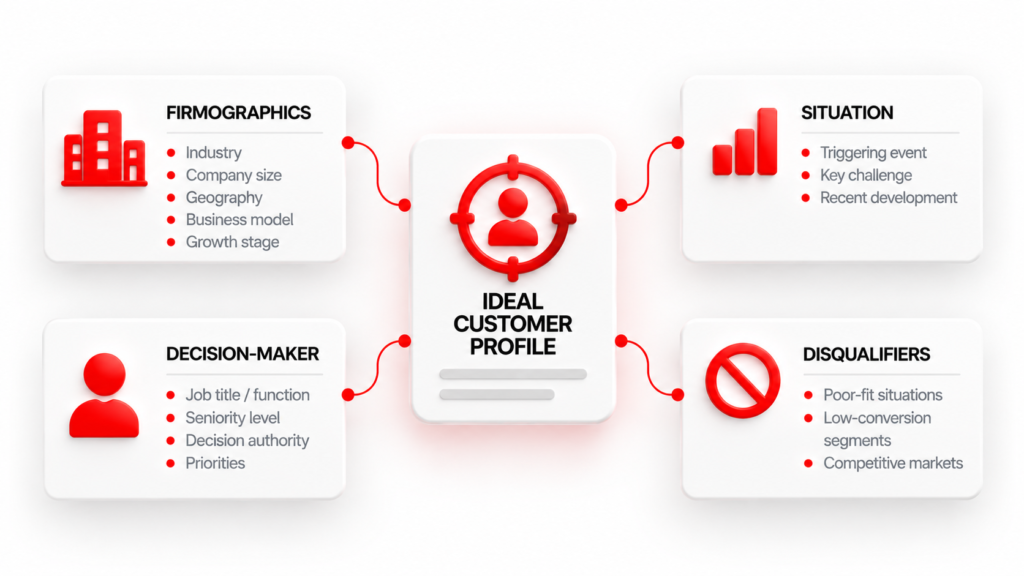
A useful ICP for outbound email typically includes several layers of specificity:
Firmographic criteria
The baseline descriptors of what kind of company is being targeted:
- Industry or vertical (specific, not broad categories like “technology” or “professional services”)
- Company size by employee count and revenue range
- Geography and market focus
- Business model (SaaS, services, product, marketplace, etc.)
- Growth stage (early stage, scaling, established, enterprise)
Situational criteria
The specific circumstances that make a company a strong fit right now:
- A triggering event or growth stage that creates urgency for the offer
- A specific challenge or bottleneck the company is likely facing given its size and stage
- A recent development (funding, hiring surge, market expansion, leadership change) that signals readiness or need
Decision-maker criteria
Who within the target company makes or influences the buying decision:
- Job title and function
- Seniority level and decision-making authority
- Typical priorities and pressures for that role at that company stage
Disqualifying criteria
The characteristics that make a company a poor fit, even if it meets the surface-level criteria:
- Company types or situations where the offer consistently does not land
- Segments that generate high interest but low conversion
- Markets where the competitive environment makes the offer less differentiated
How to build an ICP from real data
The most reliable ICP is built from evidence, not assumptions. A few sources that consistently produce useful signal:
Existing clients. The companies already buying and getting value from the product or service are the clearest evidence of who the ICP actually is. Analyzing what they have in common, beyond just industry and size, often reveals patterns that assumptions would never surface.
Won and lost deal data. Comparing the characteristics of deals that closed against deals that stalled or were lost reveals where fit is genuine versus where it only appears to be on the surface.
Sales conversations. The objections, questions, and situations that come up consistently in sales calls contain direct evidence of who has the problem being solved and who does not.
Client outcomes. Clients who get the best results from the product or service are often the clearest signal of where fit is strongest. Strong outcomes indicate genuine alignment between what is being offered and what the client actually needs.
How the ICP shapes every other campaign decision
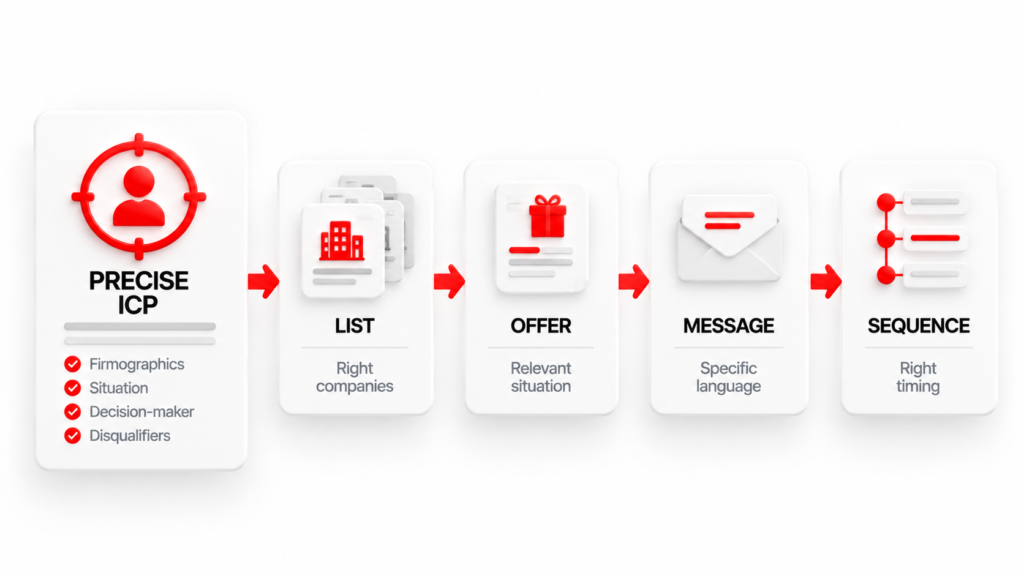
A precisely defined ICP does not just inform the list. It cascades through every element of the campaign.
The list. Every contact on the list should be evaluated against the ICP before being included. An ICP-driven list is built contact by contact against specific criteria, not filtered from a broad database after the fact.
The offer. A precise ICP makes it possible to build an offer around a specific situation that the target companies are likely facing right now, rather than a generic value proposition designed to appeal to everyone.
The messaging. Copy written for a precisely defined ICP can reference real, specific situations, use the language the target persona actually uses, and address the exact obstacles most likely to be standing between the prospect and their goal.
The sequencing. Follow-up logic and timing can be calibrated to how the target persona actually makes decisions, rather than a generic sequence designed to work across any audience.
ICP mistakes that undermine campaign performance
Even teams that invest time in ICP development sometimes make mistakes that reduce its practical usefulness:
- Defining the ICP by committee without grounding it in data. An ICP built primarily from internal opinions about who should be a good customer often diverges significantly from who actually is a good customer.
- Confusing aspirational targets with proven fit. Targeting enterprise companies because they represent large contracts, when the product or service has only been proven with mid-market, is an ICP based on aspiration rather than evidence.
- Treating the ICP as permanent. A company’s ideal customer evolves as the product matures, the team scales, and the market shifts. An ICP that was accurate eighteen months ago may no longer reflect where fit is strongest today.
- Building one ICP for the entire company. Different products, services, or use cases within the same company often have meaningfully different ideal customers. A single ICP trying to cover all of them ends up precise for none of them.
How to know when an ICP needs to be revised
A few signals that the current ICP may no longer be accurate:
- Consistently low reply rates across well-executed campaigns. If campaigns are being run competently but replies are not coming, the targeting definition may be off rather than the execution.
- Strong performance in one segment but not others. If certain types of companies within the current ICP are responding well while others are not, the ICP may need to be narrowed to the segments where fit is actually strongest.
- A pattern of late-stage deal losses. If prospects are engaging through the campaign but not converting, the ICP may be capturing companies that have the problem but not the urgency, budget, or authority to act on it.
- Significant changes in the product or market. A major product update, a new use case, or a significant shift in the competitive landscape are all reasons to revisit whether the current ICP still reflects where fit is strongest.
FAQ
How specific should an ICP be?
Specific enough that a list builder could apply it to evaluate any individual company and arrive at a clear yes or no. If the criteria are vague enough to require judgment calls on the majority of companies evaluated, the ICP needs more specificity.
How many ICPs should a company have for outbound campaigns?
As many as there are meaningfully distinct segments with different needs, buying processes, and decision-makers. For most B2B companies running outbound, one to three well-defined ICPs covering distinct segments is more useful than a single broad one trying to cover everyone.
Can the ICP be refined mid-campaign based on performance data?
Yes, and it often should be. Campaign data frequently surfaces patterns about which sub-segments are responding well and which are not, providing real evidence for ICP refinement that was not available before the campaign launched.
What is the difference between an ICP and a buyer persona?
An ICP describes the ideal company. A buyer persona describes the ideal individual within that company. Both are necessary for a well-targeted outbound campaign, and each informs the other. The ICP determines which companies to target; the buyer persona determines who within those companies to approach and how to communicate with them.
An ICP defined with real precision is not a constraint on a campaign. It is what makes precision possible across every other element, from the list to the offer to the copy. Getting it right before the campaign launches is the single highest-leverage thing that can be done to improve the odds of consistent results.
Comments are closed.